Short answer
What matters most
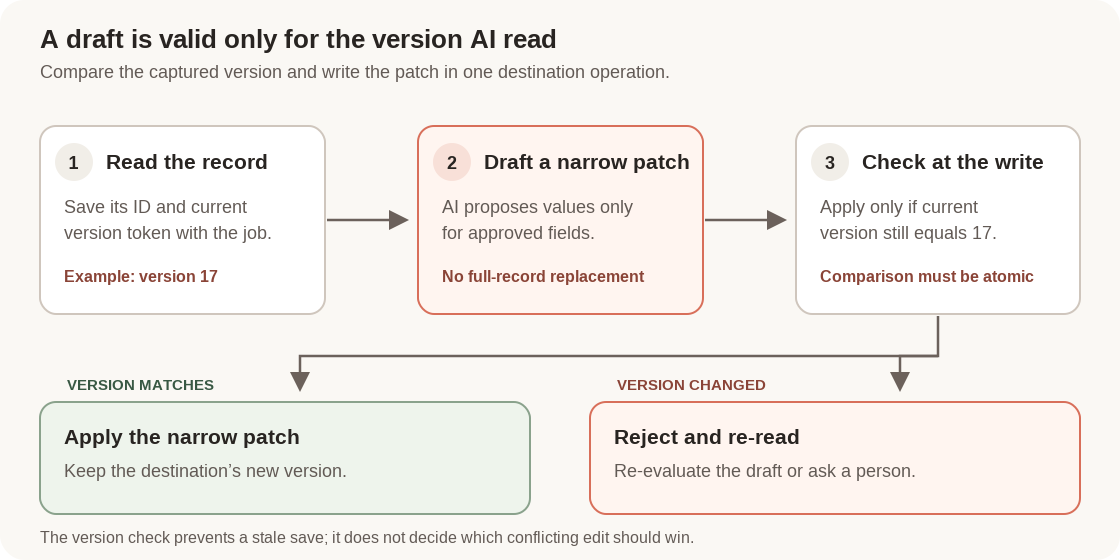
Capture the record’s version when the AI reads it, and make the final update conditional on that same version. The destination must reject the write atomically if anything changed in the meantime. On conflict, fetch the new record and compare the proposed fields; automatically retry only when you can prove the changes do not conflict, otherwise leave a draft for a person. If the target offers no atomic version check, keep updates serialized or approval-only.
Treat the draft as a versioned proposal
An operations coordinator asks an assistant to mark a service ticket “waiting on parts” and add a note. The workflow reads the ticket, then the coordinator updates it with a delivery confirmation while the AI is drafting. If the automation saves the old record snapshot, it can erase the newer change.
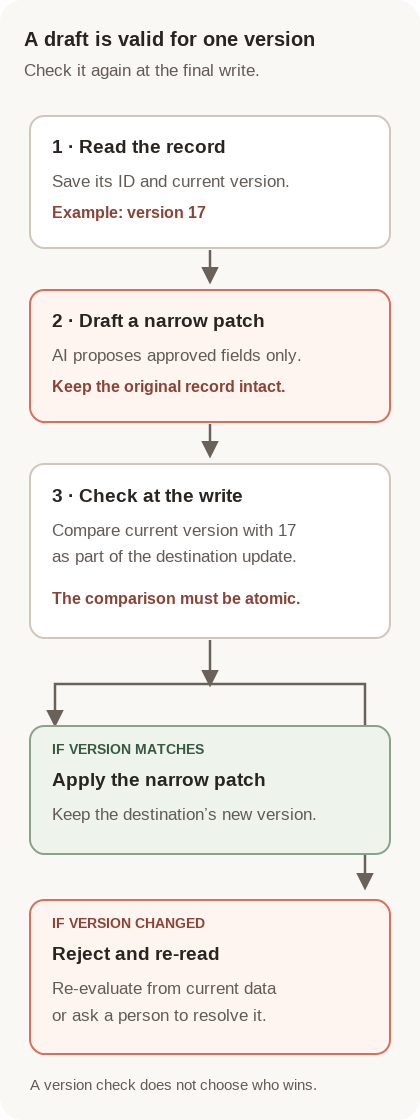
Keep the record version that was read beside the AI’s proposed fields. At save time, ask the destination to apply the narrow update only if that version is still current. If the record changed, stop and read it again before deciding what to do. The diagram shows the comparison at the write boundary, where the system can still prevent a stale patch from becoming live data.
The model can interpret the request and prepare a draft. The application should choose the record, limit the fields, supply the expected version, and handle a conflict. This pattern is often called optimistic concurrency: let work proceed, then save only if the underlying record stayed unchanged.
Make the save conditional
The version comparison must happen as part of the destination write. A separate check followed by an ordinary update leaves a gap: another person or process can change the record between those two requests. An HTTP API that supports conditional writes can use an ETag with If-Match; a database API may expose a row version or a condition expression. These are examples of native controls to check in the target you already use.
A version mismatch is a useful stop signal, not a merge decision. Re-read the current record and compare it with the proposed fields. Rebase only when your application can prove the edits are independent and the business rules still hold. If the same field or underlying meaning changed, create a new draft from current data or ask an operator.
HTTP defines If-Match for lost-update protection
RFC 9110 says If-Match is commonly used with state-changing requests to prevent accidental overwrites when clients act on the same resource in parallel. The origin server evaluates the condition before applying the method; if the tag does not match, the method must not be applied. This helps only when the destination exposes and enforces the conditional write.
RFC 9110, Section 13.1.1 (June 2022)A native feature can still be disabled
Microsoft documents version-mismatch and concurrency-disabled errors for Dataverse optimistic concurrency. Check whether the relevant table and update path support the feature; the presence of a version value alone does not prove the write will check it.
Microsoft Learn: Optimistic concurrency in Microsoft Dataverse (updated September 2, 2026)Conditional writes are target-specific
AWS documents condition expressions for DynamoDB PutItem, UpdateItem, and DeleteItem. The expression must evaluate true for the write to proceed. Treat this as an example of a native conditional-write capability, not a feature every CRM, spreadsheet, or API provides.
AWS: DynamoDB read and write operations (checked November 27, 2026)Choose a conflict path the target can enforce
Use the simplest control that covers every writer of the record. A queue works only when all updates pass through it. A version token works only when the destination compares it atomically with the write. If another application or a person can bypass the control, the workflow still needs a conflict-safe path.
On a small screen, scroll the table to read every column.
| What the destination supports | Write path | Acceptance check |
|---|---|---|
| Atomic ETag, row-version, or condition check | Send the version captured at read time with a narrow conditional update. | Change the record after AI reads it; the old version is rejected and the human edit remains. |
| No version token, but every writer uses one queue | Serialize updates by record and re-read immediately before the queued write. | Run two edits for one record; confirm each is applied against the latest saved state. |
| Independent writers with no atomic check | Keep AI at draft-only or require a person to resolve changed records. | Change or withhold the current version; confirm the workflow makes no automatic write. |
Walk through a hypothetical ticket change
Hypothetical example: the assistant reads ticket 482 at version 17 and prepares a status update. Before it saves, an operator records that the parts arrived and adds a note. The AI request still carries version 17, so the destination rejects it when the current ticket is version 18. The workflow reloads the ticket; because the new note changes the facts behind the proposed status, it leaves the record alone and asks the operator to confirm the next step.
The useful handoff is small: record ID, version read, fields the AI may propose, proposed values, and what happens on a conflict. The spreadsheet and database synchronization case study describes a conventional integration that handled changing data and conflicts. It is relevant context for conflict handling, not evidence that a model performed those updates.
Test the stale-write path before enabling writes
A successful edit proves only that the ordinary path works. Include a concurrent change between read and save, and verify the outcome at the destination. Also try a missing version, repeated conflicts, and an edit to a field outside the AI’s allowed patch. If any case silently replaces a human update, keep the workflow in draft or review mode until the write boundary is fixed.
Before connecting a model to shared records, confirm which system owns the version check and who resolves conflicts that cannot be merged safely. I can help map that boundary as part of my AI engineering work. Bring one example of a record that staff may update while an automation is running, and I can help decide how to handle it.
- Save the version read with the AI’s draft.
- Reject the update if that version changed before the write.
- Confirm a stale attempt preserves the newer human edit.
- Route repeated or same-field conflicts to a person without retrying indefinitely.