Short answer
What matters most
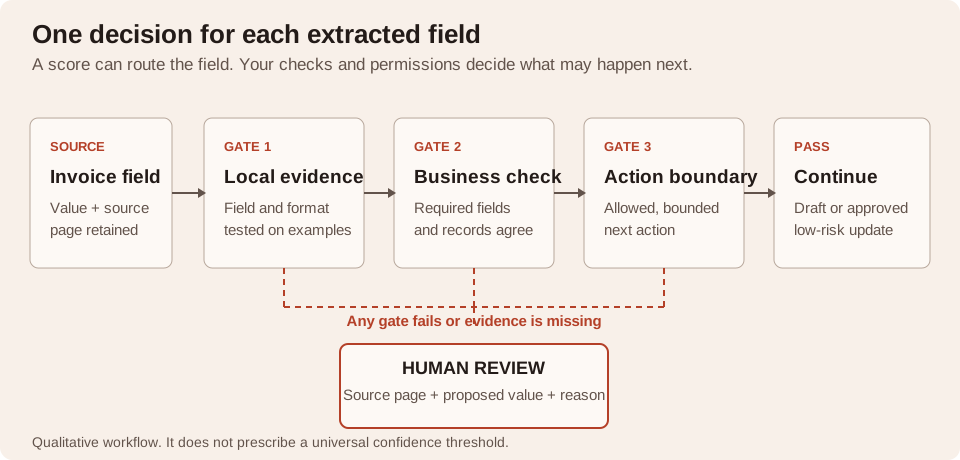
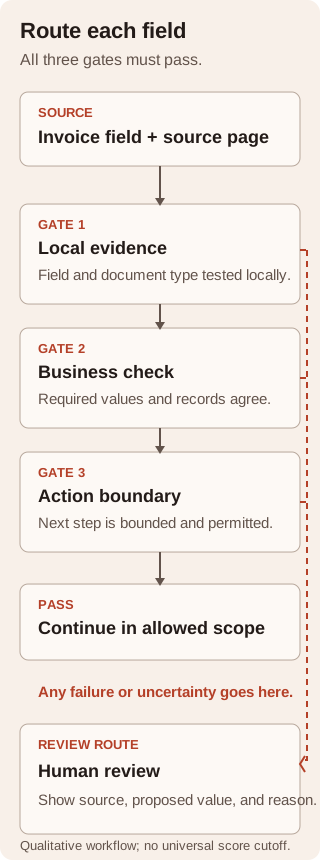
Route each extracted field using three checks: evidence from representative examples, business validation, and the consequence of the next action. Auto-accept only when the field has passed the first two checks and the update is within an approved low-risk scope. Send uncertain or conflicting values to a reviewer. Keep consequential actions under human approval even when extraction appears confident. No universal score cutoff fits every field.
A quick route through the decision
Start with the evidence, apply three field-level gates, then design the human handoff.
Treat confidence as one signal
When an invoice arrives in accounts payable, a field can look tidy and still belong to the wrong supplier or purchase order. The cost appears later, when a plausible value becomes a record that someone has to reconcile. The useful question is what should be true before each field moves beyond review.
Keep the source page with its extracted value. Then pass the field through the flow below. A confidence score can help route a value; a business check decides whether it matches your records, and an action boundary decides what the software may do.
Scores can be tied to individual fields
Google Document AI documents per-entity confidence and low-confidence manual-review triggers. That gives a workflow a routing signal, not a business rule for writing a record.
Google Cloud: Custom extractor overviewA stricter cutoff changes what reaches review
Google's evaluation guidance says a higher confidence threshold generally increases precision and lowers recall. A stricter cutoff can catch more uncertain predictions, while also sending some correct values to review.
Google Cloud: Evaluate performanceThe consequence of an error matters
AWS advises considering confidence alongside use-case sensitivity and says the suitable threshold depends on the application. I treat this as a reason to separate extraction from permission to take a consequential action.
Amazon Textract: Best practicesA native flow may already expose the signal
Microsoft documents field and supported table-cell confidence outputs in Power Automate. If your current document model and flow expose the checks you need, you can begin with its existing conditions and review path.
Microsoft Learn: Document processing in Power AutomateMake the policy field by field
Choose a threshold from labeled examples for the field and document types you actually handle. Keep a separate set of examples out of tuning, record corrections and false accepts, and revisit the policy when formats or extraction models change. If there is not enough evidence yet, route that field to review instead of borrowing a cutoff from another workflow.
Apply the rule to both the value and its next action. A confident supplier name does not prove that the supplier exists in your system, and an extracted total does not prove that it matches an order. A document-level pass should not hide a field-level conflict.
On a small screen, scroll the table to read every column.
| Decision check | Continue automatically when | Send to human review when |
|---|---|---|
| Extraction evidence | This field and document type were checked on representative examples, and the local threshold is acceptable for this action. | The score is absent or uncertain, the input is unfamiliar, or the field has not been evaluated. |
| Business validation | Required values, formats, and cross-checks against an authoritative record pass. | A value is missing, duplicated, conflicting, or fails a deterministic business rule. |
| Action authority | The update is explicitly allowed in a bounded, reversible scope. | The next step moves money, changes access, or makes a commitment; keep it behind an authorized person's approval. |
Worked scenario: a hypothetical invoice
Suppose an accounts-payable team wants to create draft records from supplier invoices. A document model extracts the supplier, invoice number, and total. The flow checks the supplier against the vendor list, looks for a duplicate invoice number, and compares the total with the purchase order.
If the fields pass the team's local evaluation and those checks agree, the flow can prepare a draft record while keeping the original invoice attached. If the purchase order is missing or the total conflicts, send the affected value and the failed check to review. Do not treat an unavailable match as a successful match.
Even when the extracted values appear confident, I would leave payment release inside the existing approval process. A model score describes extraction confidence; it does not authorize spending. This is a hypothetical design example, not a client result.
Make the exception easy to resolve
Give a reviewer the original page or field region, the proposed value, its score when available, the rule that failed, and the action waiting on the decision. Let the reviewer correct or accept the field and record why. A queue that shows only a number transfers the search work to the person and makes the decision harder to explain later.
Use the document platform's native flow first when it can expose the required score, check an authoritative record, preserve the source, and collect a human decision. Custom engineering needs a concrete gap, such as a cross-system check or reviewer context the current tools cannot provide. My enterprise document automation case study describes work that checked extracted fields against business rules and connected approved records to existing systems.
If you are setting this up, bring one document type, its current validation rules, and an example of a failure you need to contain. I can help map the review boundary and the smallest useful build.