Short answer
What matters most
For AI document automation, request an itemized estimate built from representative files and one defined end-to-end outcome. Separate document-analysis usage, model and tool usage, automation licenses and connectors, integration work, exception review, and ongoing support; state page-counting, region, volume, retries, and correction assumptions. Compare quotes only when the same document mix and acceptance rule are included. Without those assumptions, a per-page or monthly figure is not a comparable project estimate.
Quote the finished job
Two estimates can both say “invoice extraction” while one covers clean, single-page PDFs and the other must interpret scanned packets, check purchase orders, and prepare an ERP record. The label does not tell you whether the same work is being priced.
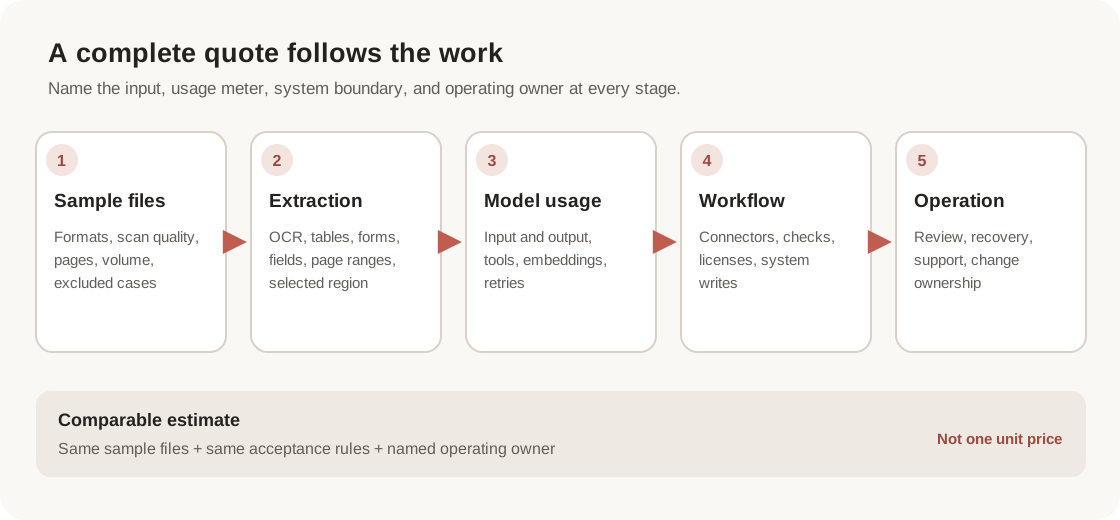
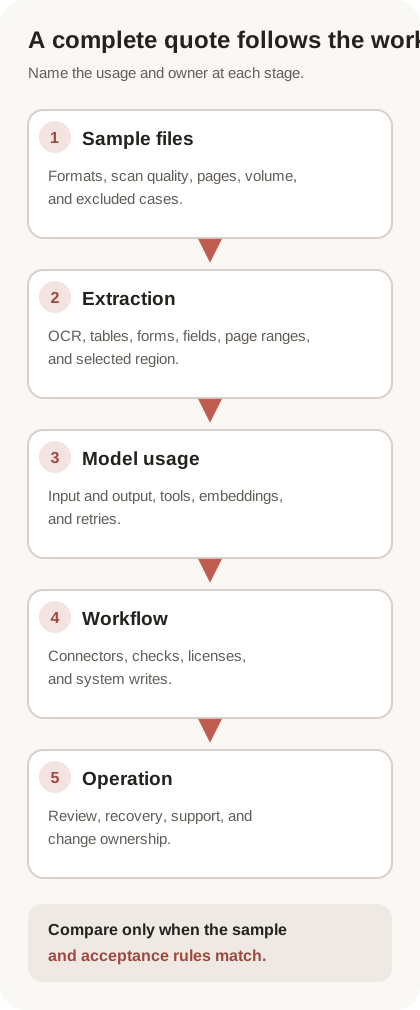
Give each supplier a sample set, the fields the finished record needs, the system it must reach, and the rule for sending uncertain cases to a person. The diagram follows the cost path from those inputs through operation. It is a way to spot missing quote lines, not a claim that every project needs a separate product for each stage.
Treat per-page pricing as one line item
A page is not always the same unit of work. OCR, tables, forms, queries, and custom extraction can be separate features, and a quote should say which are included. Ask the supplier to identify the exact service or model, region, document features, and expected pages that their estimate assumes.
The estimate should also say how it counts a document and whether every page is analyzed. For a digital form with a few relevant pages, a supported page-range option may change the amount processed. For a mixed packet, make clear whether blank pages, attachments, or unsupported formats enter the quoted volume.
Extraction features can change the meter
AWS lists separate Textract APIs and combinations for text, forms, tables, queries, signatures, and specialized documents. Its pricing page provides a calculator and feature-specific examples; it does not make an unspecified “per-page” line comparable across workflows.
AWS: Amazon Textract pricing (checked October 29, 2026; no update date shown)A document can be limited to selected pages
Microsoft documents a pages parameter for multi-page PDFs and TIFFs; without a range, the whole document is processed. This applies to Azure Document Intelligence REST API versions listed on the page, not every provider or file type.
Microsoft Learn: Document Intelligence FAQ (updated October 19, 2026)Separate model usage from workflow licensing
If extraction calls a language model, request the expected input and output usage, selected model, and any tool or embedding charges as separate assumptions. Microsoft’s pricing guidance separates content extraction, contextualization, model tokens, and embeddings where used. OpenAI’s API pricing also prices model tokens and describes additional usage for some built-in tools. These are different meters; a model’s token price alone is not a workflow estimate.
Automation software can have its own license boundary. For example, Microsoft documents user-based and capacity-based Power Automate licenses, with entitlements that depend on the flow and capability. Ask the person preparing the estimate to check the buyer’s current plan, premium connectors, action limits, and unattended runs rather than treating “the automation platform” as a single included cost.
AI document processing can have layered usage
Azure Content Understanding separates extraction from contextualization and generative model usage, and recommends testing representative files and schemas before estimating. The page distinguishes GA behavior from some preview workflow details; rates depend on region, deployment, and model.
Microsoft Learn: Azure Content Understanding pricing (updated October 7, 2026)Workflow licenses have different scopes
Power Automate documents user licenses and capacity licenses assigned to automations. This is a Microsoft-specific licensing example; check the buyer’s actual tenant and do not transfer its terms to another platform.
Microsoft Learn: Types of Power Automate licenses (updated September 22, 2026)Compare the estimate line by line
Use the same completed job and failure cases when asking for estimates. Leave a line marked “not included” when it does not apply; that makes omissions visible without forcing an unnecessary service into the design.
On a small screen, scroll the table to read every column.
| Estimate line | Assumption to state | Evidence to request |
|---|---|---|
| Input documents | Formats, scan quality, pages per file, monthly range, and excluded cases. | Representative sample set and observed page counts. |
| Extraction and model | Selected features, region, model, input/output usage, and retry policy. | Usage from a small run on the same sample and target schema. |
| Workflow and systems | Connectors, validation rules, target fields, writes, and existing licenses. | A field map and a demonstration using the intended system boundary. |
| Human review | Which cases stop, what context the reviewer sees, and who resolves them. | Examples of accepted, rejected, incomplete, and conflicting documents. |
| Operation | Monitoring, failed-run recovery, changes, support owner, and recurring charges. | A named owner, escalation path, and clear included/excluded list. |
Test one hypothetical quote
Suppose an operations team wants supplier invoices turned into draft records. This is a hypothetical example, not a client result. The input pack contains both digital and scanned PDFs; the output needs supplier, invoice date, total, and line items; the workflow checks a purchase order and pauses for approval before writing to the finance system.
A useful estimate would state how the sample mix maps to extraction features, how many pages and model calls are assumed, how purchase-order mismatches reach a reviewer, what the integration writes, and who supports failed runs. Ask for a small, measured sample before accepting projected usage. Do not treat one clean invoice as proof for every supplier format.
- Sample files and excluded formats: ______
- Expected documents and pages per period: ______
- Required fields, checks, and approval boundary: ______
- Target system, connectors, and existing licenses: ______
- Exception owner, recovery path, and recurring support: ______
Use the simplest route that passes
Start with the extraction, approval, and connector features already available in the company’s platform if they can handle the sample set and required controls. Manual review can remain the better operating choice for rare or ambiguous documents. Custom engineering is worth estimating when a specific gap remains, such as a required cross-system check, controlled write, or reconciliation trail.
My document-automation case study describes one specific enterprise engagement; it is not a typical price or a promise that another workflow needs the same architecture. I can help define the sample, acceptance rules, and system boundary before you compare implementation estimates.