Short answer
What matters most
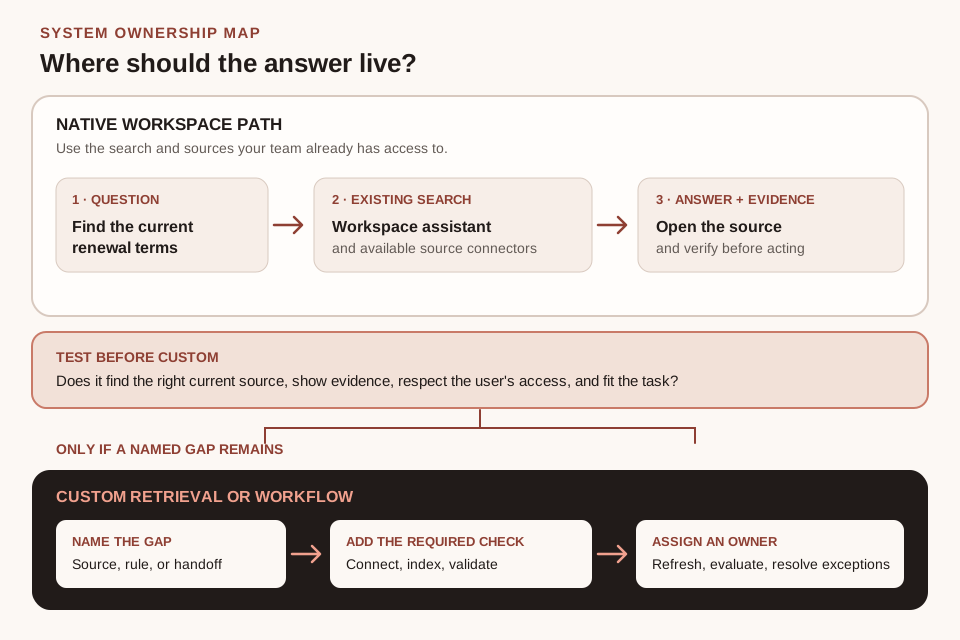
Start with your existing workplace search or assistant when it can reach the approved sources, return useful source links, and fit the task. Configure its scope or add a supported connector when source coverage is the gap. Build custom retrieval only when a specific requirement remains, such as a cross-system check or controlled handoff. Test representative questions and verify the underlying records before relying on answers.
Trace what happens after the question
A manager asks for the current renewal term, but the team searches several folders and asks around before finding the agreement. A custom assistant can sound like a direct fix. The wrong choice can leave you operating a second index and permission path when the information was already available through workplace search.
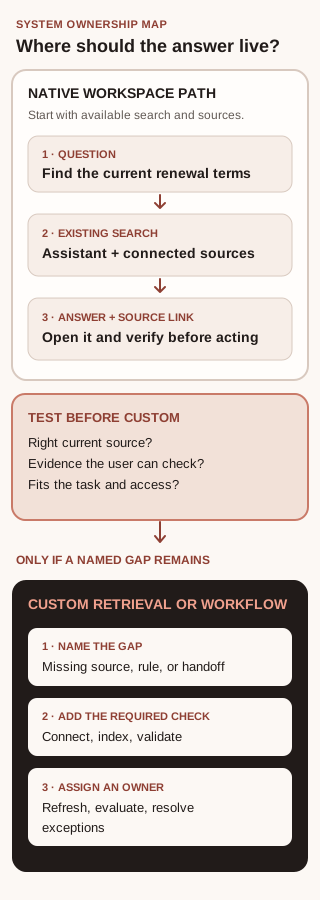
The map shows where the work lands. Begin with the search or assistant your organization already has, then check whether it can reach the right source and return evidence a person can verify. Add a custom layer only for a named source, check, or workflow gap that remains after native setup has been tested.
Start with what your workspace already searches
A native assistant can already cover common questions about policies, agreements, or project files. Google documents natural-language questions in Drive search that can return an AI Overview from files with links to sources. Microsoft documents Copilot Search across Microsoft 365 data and connected sources. These are examples of current product capabilities, not a promise that every account, connector, or source is available in your environment.
Check the actual feature access, source coverage, setup, and user permissions in your tenant. If the right information is in scope and a person can verify the returned source, test the native path with real recurring questions before commissioning another search application.
Drive search can answer in place
Google's Drive help describes natural-language search and an AI Overview drawn from files with links to sources. That is a reason to test the workspace search surface first; it applies only to the feature and files available to that user.
Google Drive Help: Search for files in DriveA source gap may have a native connector
Microsoft documents synced and federated Copilot connectors for data beyond Microsoft 365, including source permission handling. Check the connectors supported and configured for your tenant before treating an external source as a reason to build a separate assistant.
Microsoft Learn: Copilot connectors overview (updated September 22, 2026)Treat a source link as a place to verify
A source link is useful because it gives a person somewhere to check. It is not a quality score. Open the file, confirm it is the current authority, and compare its actual wording with the answer. Check whether the assistant found the whole evidence set, especially when two policies or versions disagree.
Build this review into the first evaluation. A system that displays a citation but points to an old or unrelated document has not answered the business question safely. The same rule applies if a native interface gives you a polished summary without enough evidence to resolve the decision.
Citations still need a human check
Google warns that Gemini may miss a source it used or cite a document that does not directly support a specific statement. Verify the source content itself; the presence of a citation does not establish that an answer is correct.
Google Drive Help: Use sources with GeminiUse the task to locate the custom gap
Compare systems against one recurring job, not a general wish for a more intelligent search box. State what the user asks, which records count as authoritative, what the answer must contain, and what happens next. Then try the native search, its available source controls, and any supported connector that fits that job.
Use this matrix to name the failure you still need to solve. A custom layer is justified by a specific missing capability after that check, not by the fact that an AI answer would be attractive.
Custom retrieval adds work someone must own
Azure AI Search's RAG guidance names content preparation, multi-source access, query understanding, and governance among implementation challenges. This is Azure's product guidance, not a universal effort estimate; use it to assign an owner to every added source and check.
Microsoft Learn: RAG in Azure AI Search (updated August 4, 2026)On a small screen, scroll the table to read every column.
| Recurring job | First path to test | Custom gap to prove |
|---|---|---|
| Find a policy or decision | Workplace search or assistant with source links | An approved source stays outside supported search after native connection options are checked. |
| Summarize a known set of files | Native assistant with the right files, folders, or source scope | The answer needs a repeatable rule or structured result the native controls cannot enforce. |
| Turn an answer into business work | The existing business app or an approved workflow around the answer | A required cross-system check or controlled handoff remains unsupported after configuration. |
A hypothetical renewal question across two systems
Suppose an operations lead asks, “What renewal terms did we agree, and does the current policy allow this change?” The agreement is in a shared document workspace, while current account status lives in a CRM. This is a hypothetical example, not a reported client engagement.
First test what the available native search and connectors can retrieve for a user with the required access. Open the agreement and account record, check whether they are current, and see whether the answer distinguishes documented terms from the policy interpretation. If those sources and the review step fit, stop at the native path.
If a live account field must be compared with a policy rule or turned into a controlled draft, name that requirement and check whether the existing platform can handle it. Only if that gap remains does custom retrieval or workflow engineering become a candidate. The production knowledge-search case study shows one real custom system; it is evidence that such a system can be built, not that every organization needs one.
Write a fit brief before a custom build
A short fit brief makes the decision repeatable and gives a technical lead a bounded starting point. Use it to compare the native path with a proposed extension on the same questions and source records.
- User question: what do people ask, and how often does it recur?
- Source of truth: which files or records are authoritative, and who keeps them current?
- Access: which users should see each source, and where is that permission defined?
- Expected answer: what evidence, fields, or next step must appear?
- Native test: which search settings or connectors did you try, and where did they fail?
- Named gap and owner: what must custom work add, and who will maintain sources and review exceptions?
Choose the smallest path that closes the gap
If the native test passes, configure it and document the sources, permissions, and review step. If it fails, match the next change to the failure: adjust source scope, check a supported connector, or add a narrow custom retrieval and validation layer. Each extra system needs someone responsible for its access, refresh, answer review, and fallback.
Bring one recurring question, the source records behind it, and the fit brief to the next decision. I can help assess whether your current search is enough or identify the smallest custom extension worth evaluating.